
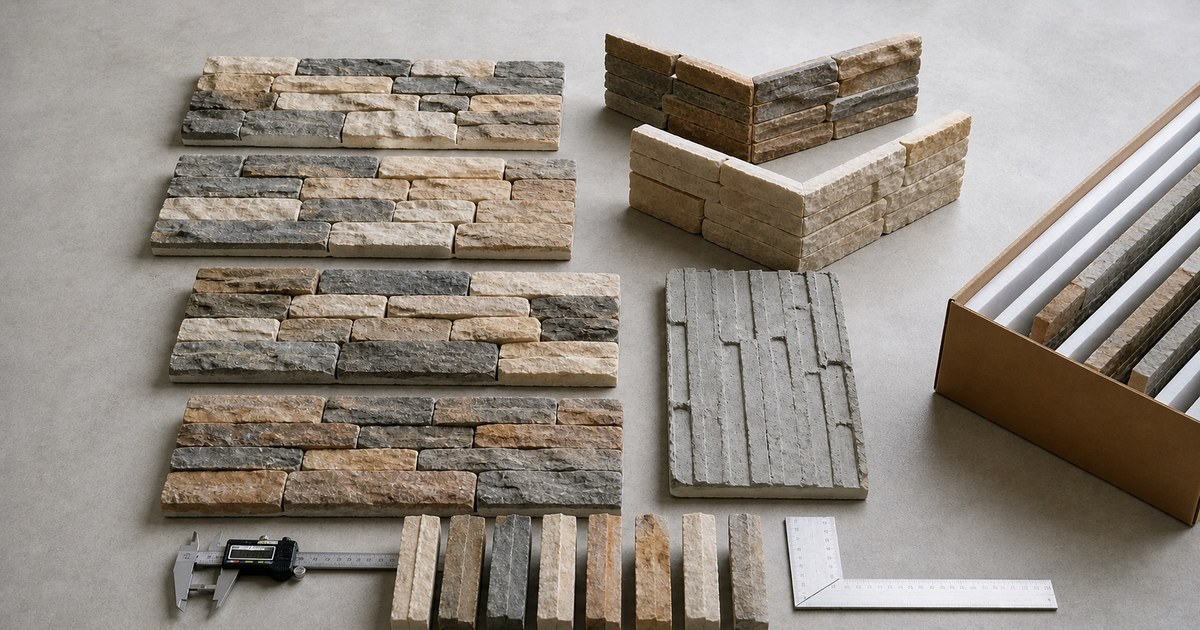
SOURCING GUIDE · MANUFACTURED STONE VENEER QUALITY · ORDER CONTROL
Manufactured Stone Veneer Quality Control: Flats, Corners, Backs and Colour Mix
Manufactured stone veneer quality control should use a written checklist to freeze the exact material and component schedule. Buyers should then approve a representative colour and texture range and verify flats and corners together. Finally, inspect packing and quantity distribution before shipment.
Manufactured veneer is not a single universal material and should not be described as natural stone unless it is actually natural stone. Suppliers may use different binders, aggregates, pigments, surface treatments, backing profiles and production processes. The buyer file needs the supplier’s exact product description and evidence rather than a category-level assumption.
TILE IN CHINA is a sourcing service operated by LEIYUAN INDUSTRIAL CO.,LTD. (“LEIYUAN”). We help buyers organise comparisons, samples, factory communication, order follow-up, inspection and shipping for manufactured stone and brick veneer. The responsible project team must decide system design, structural attachment, substrate preparation, fire or weather requirements, installation and destination compliance.
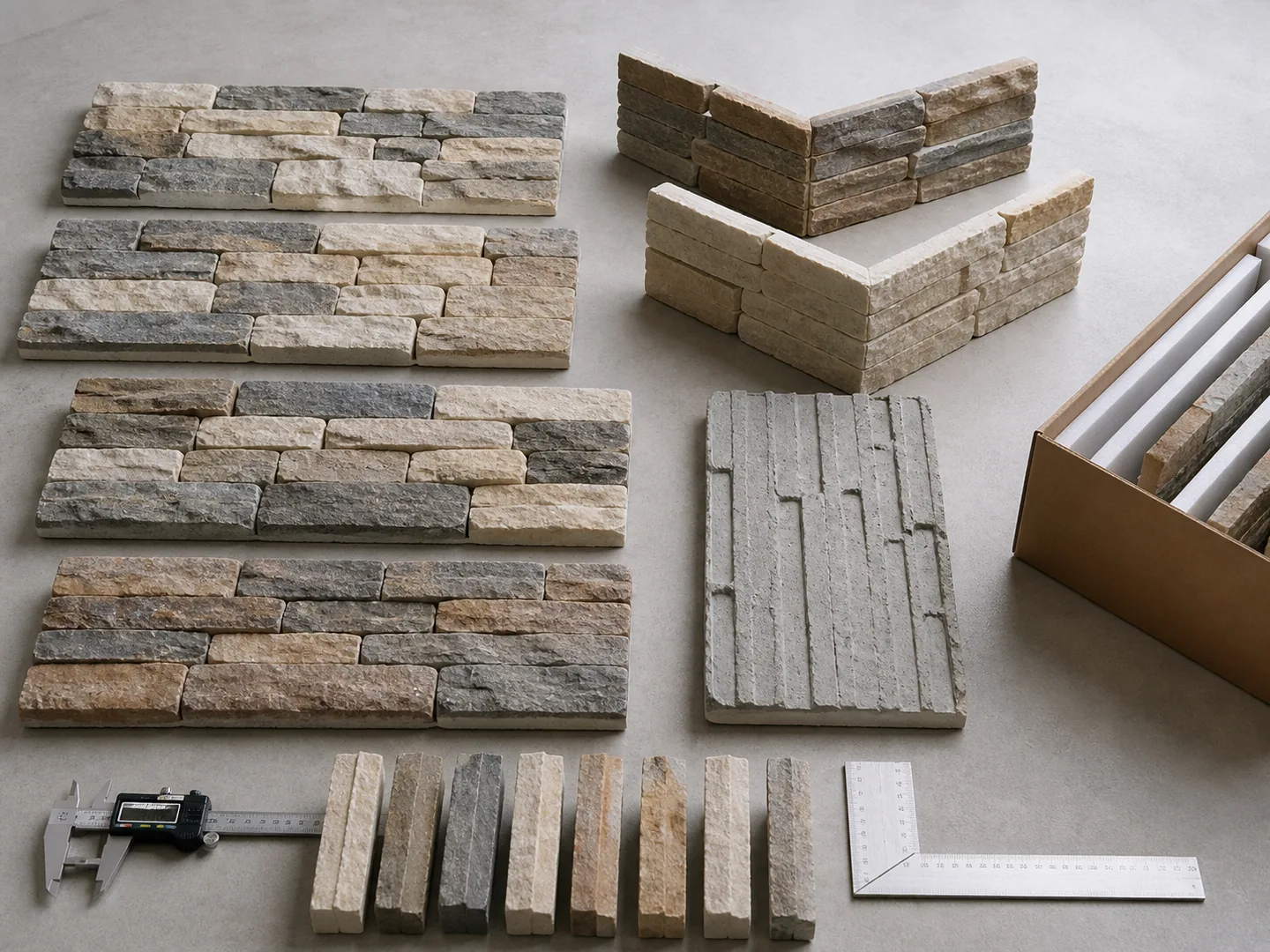
Manufactured Stone Veneer Quality: Control the Whole System
A convincing front face can hide practical order risks: corner pieces may not coordinate with flats, the colour mix may drift from the approved board, thickness may affect setting out, and dense packing may damage projecting texture. Begin with elevations, the proposed bond or layout, corner strategy and a schedule of flats, corners and special pieces.
The veneer supply should also be separated from the wall system. The substrate, water-management layer, adhesive or mortar, mechanical restraint, movement detailing and local fire or structural decisions may involve other manufacturers and qualified professionals. A veneer catalogue does not approve the complete façade or wall assembly.
Flat Pieces
Define format mix, face profile, nominal dimensions, thickness range, colour distribution, joint concept and ordered area using the agreed measurement basis.
Corners & Returns
Confirm outside and inside corner geometry, leg lengths, handed pieces, visible returns and how corners visually blend with field pieces.
System Interfaces
Record the intended substrate, water-management and fixing concept, but leave engineering and system approval with the responsible project parties.
Manufactured Stone Veneer Quality Control Matrix
The matrix helps a buyer define what can be approved and sampled. Numerical acceptance limits should come from the contract, project specification and product-specific evidence.
| Control area | Define in the order | Verification route | Risk if left open |
|---|---|---|---|
| Material identity | Supplier description, code, series, colour and manufacturing source | Current datasheet, declaration, labelled samples and consistent order references | Different products are grouped under one broad veneer label |
| Flats | Format range, profile, quantity and measurement basis | Approved set, production sample and count reconciliation | Area assumptions differ between quotation and site take-off |
| Corners | Type, leg sizes, orientation, quantity and colour mix | Corner samples, elevation review and separate carton labels | Corners look unrelated or are short at returns |
| Colour blend | Target distribution, contrast and acceptable variation | Signed range board or mock-up with dated photographs | One hand-picked piece becomes an unrealistic standard |
| Surface and edges | Texture, coating if any, chips and visible-edge expectation | Controlled visual sampling under agreed lighting | Normal variation and damage are not distinguished |
| Dimensions | Nominal sizes, thickness and agreed tolerance source | Measurement sampling on flats and corners | Build-up and joint lines become inconsistent |
| Reverse and fixing | Backing condition and any actual fixing feature | Reverse-side sample and supplier installation information | The face sample hides a changed back profile |
| System evidence | Intended substrate, exposure and attachment concept | Product reports plus review by system designer or responsible professional | Component data is treated as approval of the whole wall |
| Packing | Pieces per carton, flat/corner separation, pallet and protection | Packing trial, drop/handling review if specified, loading photos | Project-critical corners suffer concentrated breakage |
Terms such as lightweight, weatherproof, non-combustible or maintenance-free need a defined meaning and scope. Do not add them to the purchase specification without suitable evidence and responsible-party review.
Manufactured Stone Veneer Quality: What Buyers Should Verify
A reliable order record describes both the intended appearance and the evidence boundaries. Verification should be linked to the exact product code and assembly responsibility.
- Material description: Obtain a clear supplier statement of what the veneer is made from and how the offered product is identified; do not infer natural stone content from appearance.
- Factory and product code: Match manufacturing source, series, code, colour and finish across quotations, samples, documents, carton labels and inspection references.
- Flat and corner schedule: Count flats, outside corners, inside corners, returns, caps and special pieces from project drawings using an agreed commercial measurement basis.
- Approved visual range: Use enough pieces to represent intended colour, texture, profile and variation. Record lighting, board arrangement and whether proportions are contractual.
- Dimensions and build-up: Agree how length, height, thickness, corner legs and joint assumptions will be sampled and reported.
- Reverse condition: Approve and inspect the actual backing profile, cleanliness and fixing feature where present, while leaving installation-system approval to the responsible party.
- Coating or treatment: If a surface treatment is offered, record its product name, application stage, supplier guidance and supporting evidence rather than assuming permanent protection.
- Project-relevant evidence: Request reports or declarations that address the specified exposure or regulatory question and confirm exact specimen scope.
- Packing segregation: Require separate, readable labels for flats, corners, colours and special pieces, plus protection that considers projecting profiles.
- Replacement policy: Set the spare quantity and retain the approved identity record because later colour or texture matching may be constrained by production variation.
Manufactured Stone Veneer Quality Control in Four Stages
The sequence keeps visual approval, technical review, production communication and packing control connected to the same product identity.
1. Schedule
Translate elevations into a component schedule with flats, corners, returns, colours, quantities, destination, intended substrate and open technical questions.
2. Approve the Range
Review enough face, edge and reverse samples to understand variation. Approve a dated board or mock-up and document how colour proportions should be interpreted.
3. Freeze the Order File
Align the quotation, specification, evidence register, samples, packaging and inspection plan. State who may approve substitutions or range deviations.
4. Check and Pack
Sample flats and corners, reconcile component counts, compare the visual range, check labels and packing, and record any limits before container loading.
Keep Manufactured Stone Veneer Quality Evidence Within Its Tested Boundary
Manufactured veneer may be described using category language that varies by supplier and market. Buyers should request the underlying document, identify the tested material and specimen, and avoid translating a component result into an assembly claim. Fire, structural, moisture and weather decisions often depend on the complete wall build-up and destination rules.
Visual inspection is valuable for identity, range, workmanship, dimensions, quantity and packing, but it cannot prove concealed composition or installed-wall performance. When those matters are important, require appropriate declarations, traceable tests or qualified project review, and record what remains outside inspection scope.
- Retain the original report or declaration with report number, issuer, date and specimen description.
- Check whether the evidence names the same manufacturing source and product code as the order.
- Separate component test results from wall-assembly approvals and design calculations.
- Do not use images of a flame, rain or completed façade as substitute evidence.
- Record any coating, mesh, reinforcement or backing included in the tested specimen.
- Escalate unresolved compliance questions before deposit or production, not at the loading stage.
Manufactured Stone Veneer Quality Standards to Verify
An official publisher entry can help identify terminology and the stated scope of a manufactured veneer standard. It is not proof that a supplier product or wall assembly conforms.
- ASTM C1670/C1670M — Adhered Manufactured Stone Masonry Veneer Units — Use the ASTM entry as a route to scope and version information. The publisher page may point to a newer revision; confirm the contract edition and exact material before relying on it.
Do not state ASTM compliance unless current, product-specific evidence supports it and the responsible party accepts its applicability. Component scope must not be expanded to the complete wall system.
Related Product and Buyer Routes
Manufactured Stone & Brick Veneer
Review the commercial product route for manufactured stone and brick veneer.
Exterior Wall & Facade Tiles
Compare related exterior finish families through exterior wall and façade tiles.
Tile Sourcing for Projects
Organise drawing, sample and component schedules through project sourcing support.
Quality Inspection & Shipping
Link the approved range to inspection, packing and shipping controls.
Replacement Materials
For renovation matching, review how to source replacement finishes.
Prepare the Buyer Brief
Use the China tile sourcing brief guide to document the first request.
How TILE IN CHINA Helps
TILE IN CHINA, a service operated by LEIYUAN, can structure the component schedule, compare supplier descriptions, coordinate sample boards and corners, request traceable documents, follow approvals through production and arrange inspection and packing records before shipment. This is especially useful when several textures or components must arrive as one coherent package.
Our work does not certify material composition, engineer an attachment system or approve fire, structural, moisture or destination compliance. Those decisions belong to the responsible product issuer, designer, engineer, installer, buyer and authority. We report supplier statements and observations with their source and scope rather than presenting them as our own guarantees.
Frequently Asked Questions
Is manufactured stone veneer the same as natural stone?
No. Manufactured veneer may be designed to resemble stone, but its exact composition and process need supplier documentation. It should not be labelled natural stone unless that description is factually correct.
Why should corner pieces be approved with flats?
Corners can differ in leg size, profile, colour balance and visual rhythm. Reviewing them together helps the designer and buyer judge transitions and verify the component schedule.
How can colour variation be controlled?
Approve a representative range board or mock-up, define how colour proportions are interpreted, and compare sampled production under agreed lighting. Do not rely on one ideal sample or screen image.
Can a pre-shipment inspection prove exterior durability?
No. Inspection can check visible and measurable order characteristics, labels and packing. Durability claims require suitable product or system evidence and project-specific review.
Should fire documentation be requested?
Request it when fire performance is relevant to the project or destination, but verify the tested product and assembly scope with the responsible qualified party. A component result may not approve the complete wall.
What packing detail matters most for textured veneer?
Protection should reflect projecting faces, vulnerable corners, unit weight and handling route. Define component segregation, carton limits, pallet protection, labels and the loading plan before shipment.
Prepare a Manufactured Stone Veneer Quality Enquiry
Use this manufactured stone veneer quality control checklist when sending elevations, component quantities, target appearance, intended substrate, destination and evidence questions. TILE IN CHINA can organise a supplier comparison that keeps flats, corners, visual range and unresolved system decisions visible.